Russian folk tale
The Wolf and the Seven Little Goats
The Wolf and the Seven Little Goats — a Russian folk tale about little goats who open the door only to their mother’s song. Read the full text for free.
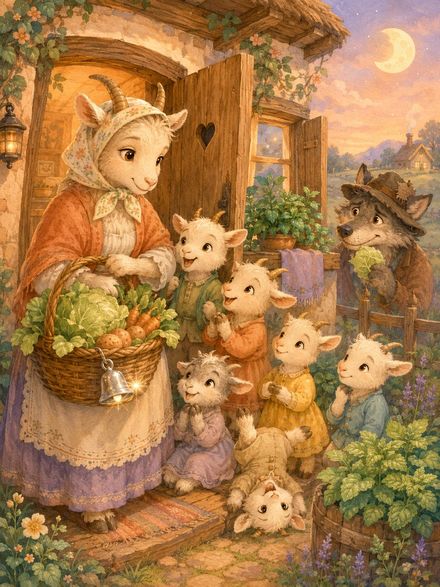
The morning smelled of warm milk and mint on the windowsill. The wise Goat was tying her kerchief by a little mirror, and seven little goats sat in a row on the bench: the eldest sitting straight, the smallest with its little hooves in the air.
“I’m going for cabbage and sweet roots,” said the Goat in her soft, ringing voice. “And you must not open the door until you hear my little song.”
And she sang: “Ding-a-ling, little horns, you hear your mother’s paths!” The little goats repeated it in chorus, and the smallest added: “And we also hear the little pies!”
The Goat set off along the path, where the dew sparkled like buttons of moonlight. And by the hazel bush stood the Wolf in an old hat. He was not scary, only very hungry for other people’s pies and other people’s doors.
“Hmm,” he grumbled. “I can sing too. Only a little... with pebbles.”
He knocked on the little house: knock-knock-knock!
“Open up, little goats, it’s your mother!”
The eldest little goat pressed its ear to the door. The voice was gruff, as if a pot had rolled down the stairs.
“No,” it said. “Our mother’s voice rings, and yours rumbles.”
And they all whispered: “Ding-a-ling, little horns, you hear your mother’s paths!”
The Wolf ran to the beekeeper and asked for a drop of honey for his throat. Then to the mill — he powdered his paws with flour. And he also found a pine cone and said to it: “You will be my little bell.”
The cone replied: “I don’t know how to ring, but I keep quiet nicely.”
The Wolf knocked again. This time his voice was sweeter.
“Little ones, open up, it’s mother with the basket!”
The middle little goat looked through the crack under the door and saw a white paw.
“The paw is white, but the steps aren’t mother’s,” it whispered. “Mother walks: clip-clop-ding. And out there: shush-shush-puff.”
The smallest was already reaching for the latch, because it wanted the sweet roots so much. But the eldest hugged it by the shoulders.
“Let’s wait for the song.”
And they said, more bravely now: “Ding-a-ling, little horns, you hear your mother’s paths!”
Then the Wolf grew cross with the cone, with the flour, and even with his own hat. He sat under the window and gave a quiet sigh. And just then the Goat returned. She saw the traces of flour, the drop of honey on the latch, and the Wolf pretending to be a bush.
“Good day, little bush,” said the Goat. “Have you seen a Wolf around here?”
“No-o-o,” answered the bush in a very wolfish voice.
The Goat smiled and jingled the silver bell on her basket. The little goats opened the door only when they heard her real little song.
“Ding-a-ling, little horns, we know our mother’s paths!” they sang.
The Wolf scratched his hat and said: “May I have at least one cabbage leaf?”
The Goat gave him one big leaf and one more — for a polite knock next time. In the evening the little house smelled of soup, mint and laughter, and on the door hung a little button of moonlight — so that even the silence would remember mother’s little song.
Listen to this tale narrated
Professional audio narration and many more tales for children aged 0–6 — in the Tale Tails app. Read or listen, even offline.
Get it on Google PlayQuestions & answers
What age is the tale “The Wolf and the Seven Little Goats” for?
“The Wolf and the Seven Little Goats” is best for children aged 3 to 5, though it is loved at any age.
Is there an audio narration of “The Wolf and the Seven Little Goats”?
Yes. A professional audio narration of “The Wolf and the Seven Little Goats” is available in the free Tale Tails app for Android.
Is “The Wolf and the Seven Little Goats” free to read?
Yes, the full text of “The Wolf and the Seven Little Goats” is free to read on this page, with no sign-up.
What is the moral of “The Wolf and the Seven Little Goats”?
Don’t rush to open the door to strangers: listen closely, check carefully, and stay near those who care for you.