Russian folk tale
The Frog Princess
The Frog Princess — a Russian folk tale about Prince Ivan, who finds his destiny in a marsh kingdom. Read the full text for free.
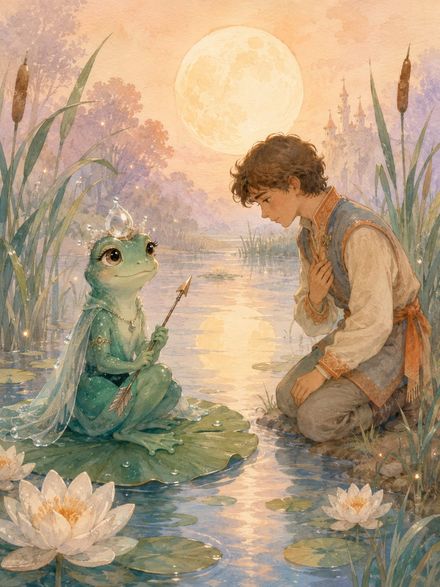
On the evening when the moon hung over the marsh like a silver bowl of milk, the youngest prince, Ivan, lost not his arrow but his own pride.
He stood knee-deep in the reeds and grumbled:
“What bad luck. My brothers’ arrows fell into fine courtyards, and mine — into a kingdom of frogs.”
“Ribbit,” answered a thin little voice. “Our kingdom is small, but our mosquitoes sing perfectly in tune.”
On a lily-pad sat a little frog. Green, round-eyed, with a drop of dew on her head, as if she wore a crown. In her paws she held Ivan’s arrow.
“Give it back, please,” said Ivan.
“I will,” answered the frog. “But by an old custom: where the arrow falls, there your destiny settles down.”
Ivan sighed so heavily that the reeds leaned over to listen.
At the palace the older brothers brought their brides: one had a necklace that jingled like a shop, the other a dress wider than the doors. But Ivan carried a little frog in his hands.
The tsar narrowed his eyes.
“Son, who is this?”
“My... destiny,” said Ivan quietly.
“Ribbit-correct,” the frog put in. “And I also embroider beautifully with dew.”
The brothers burst out laughing. Their brides covered their mouths with handkerchiefs, but their eyes laughed louder than their lips.
The tsar scratched his beard.
“Very well. Tomorrow each bride will bake bread. We shall see whose hands know how to hold warmth.”
At night Ivan sat by the window and looked at the frog.
“Forgive me,” he said. “I don’t know how to help you.”
“Then don’t get in the way,” she answered cheerfully. “Sometimes that is the very best help.”
Then she leapt onto the windowsill, and the room filled with a quiet light. The frog cast off her green skin, like a rain cloak, and before Ivan stood Princess Vasilisa. Her braid was dark as night over a river, and her eyes were kind, as if someone had lit two little stoves inside them.
By morning there lay bread on the table. Not just bread, but a round loaf with golden sides. On the crust you could see a forest, a river, a palace, and a tiny Ivan standing among the reeds with a bewildered nose.
The tsar was silent for a long time.
“This is not bread,” he said at last. “This is a whole summer that has learned to be food.”
The next day the tsar ordered the brides to weave a carpet. The older brides jingled their bracelets and ordered the maids about. But Vasilisa, at night, became herself again and wove so quickly that the threads themselves begged to join the pattern.
Ivan watched and thought: “Why must she be a frog by day? Why does such beauty hide in a cold skin?”
The thought was sticky, like honey on his fingers. It stuck to his heart.
When Vasilisa fell asleep, Ivan took the green skin and threw it into the fire.
The flame flared blue.
Vasilisa woke up. Her face was not angry, but very sad.
“Oh, Ivan,” she said softly. “You saw beauty and decided you knew the whole truth.”
The wind flung the window open. A white feather flew into the room, whirled above the candle, and turned into an old crow in a velvet hat.
“Caw! Your time has not come, the pact is broken, the princess flies beyond thrice-nine mists!” she croaked, as if reading a decree from a cloud.
Vasilisa reached out her hand to Ivan.
“Look for me not where things glitter, but where they wait without laughter.”
And she vanished.
Ivan set out on the road. He walked through forests where mushrooms argued about the weather, across a field where sunflowers turned their heads and asked: “Well then, have you grown wiser?”
On the third day he saw the marsh. The very same one. On a lily-pad sat an old frog in spectacles.
“Ribbit — good day,” she said. “Have you come for the princess?”
“Yes,” answered Ivan. “I was wrong.”
“Everyone can do that,” the frog nodded. “But what will you do next?”
Ivan sat down by the water.
“I will wait. And listen. If she wishes to speak.”
The marsh grew still. Even the mosquitoes sang in a whisper.
In the evening Vasilisa came out of the mist. Not in a golden dress, not in a crown, but in a simple green kerchief. She carried that same arrow in her hands.
“Have you come without a command?” she asked.
“I have come with a request,” said Ivan. “Teach me to see all of you, and not only what shines.”
Vasilisa looked at him for a long time. Then she smiled, and the marsh looked like a sky that had fallen to the earth and not shattered.
“Then let us go,” she said. “There are too many mirrors in the palace. They, too, must learn to be silent.”
When they returned, the brothers no longer laughed. The tsar looked at Vasilisa as if he understood for the first time: a crown does not make a person a princess if the heart is empty.
And in the morning, by the palace pond, the water lilies bloomed. On each white flower a drop of dew glittered — a small, clear crown that even a child could see, if they looked closely.
Listen to this tale narrated
Professional audio narration and many more tales for children aged 0–6 — in the Tale Tails app. Read or listen, even offline.
Get it on Google PlayQuestions & answers
What age is the tale “The Frog Princess” for?
“The Frog Princess” is best for children aged 5 to 7, though it is loved at any age.
Is there an audio narration of “The Frog Princess”?
Yes. A professional audio narration of “The Frog Princess” is available in the free Tale Tails app for Android.
Is “The Frog Princess” free to read?
Yes, the full text of “The Frog Princess” is free to read on this page, with no sign-up.
What is the moral of “The Frog Princess”?
True beauty does not always stand in the light with a crown on its head. Sometimes it sits on a lily-pad and quietly waits to be seen with the heart.