Russian folk tale
Sivka-Burka
Sivka-Burka — a Russian folk tale about the youngest son Ivan and a magical horse who helps a kind and honest heart. Read the full text for free.
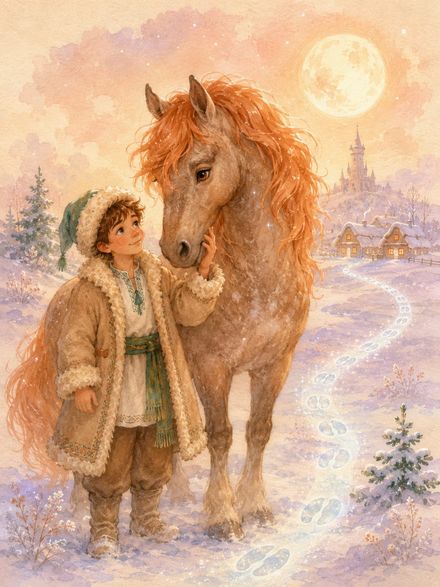
That winter, when the moon hung over the village like a silver spoon above a bowl of milk, the youngest son Ivan learned to listen to the silence.
The father had three sons. The eldest spoke so loudly that even the doors opened by themselves before him. The middle one measured everything: how much grain, how many steps, how much use. But Ivan, the youngest, had a habit of not answering at once. First he would look a person in the eyes, as if searching there for a little spark.
When the old father felt that his strength had grown thin, like the last thread in a shirt, he called his sons.
“My sons,” he said, and his voice was dry, like leaves under the snow. “After I die, come to my grave for three nights. Not out of fear. For the sake of memory.”
“We will come,” boomed the eldest. “I’m afraid of nothing!”
“If it must be, then it must be,” calculated the middle one.
Ivan only took his father’s hand. It was light, like a bird’s wing.
On the first night the eldest was to go. But as soon as the sun set, he yawned so wide that a whole night went into that yawn.
“Ivan, go instead of me,” he said. “You like being silent anyway.”
Ivan threw on his little coat and went. In the graveyard the snow glowed, as if someone had scattered crushed stars over the earth. He stood by the grave and whispered:
“I’m here, father.”
The wind ran its fingers over the dry grass. No one answered, but Ivan grew warm, as if in the darkness someone had lit a small stove.
On the second night the middle son suddenly found an important task for himself: to count all the sacks in the storeroom.
“The night is long, and numbers don’t wait,” he said. “Ivan, you’re the kind one.”
Ivan went again. This time by the grave came a soft stamping, so far away, as if the heart of the earth had struck with a hoof. Ivan was not afraid. He only laid his palm on the snow.
“If it’s you, father, I’m listening.”
Then from under the wind, from under the moon, from under the very silence, a voice sounded:
“A kind heart can’t be hidden, my son. Come tomorrow at midnight into the open field and call: “Sivka-Burka, prophetic steed, stand before me, like a leaf before the grass!””
On the third night Ivan went into the field. The snow there lay smooth, like a clean page on which no one had yet written a tale.
“Sivka-Burka, prophetic steed,” Ivan called, and the words themselves became round and ringing, “stand before me, like a leaf before the grass!”
The earth shuddered. Out of the mist came a horse: his mane burned like copper, his sides glowed like evening clouds, and his eyes were wiser than three village councils put together.
“At last,” snorted the horse. “I was already thinking you’d call me in a whisper, and I’d have to be small as a cat.”
“Can you talk?” Ivan wondered.
“No,” said Sivka-Burka gravely. “I can answer. That’s something quite different.”
The horse lowered his head.
“Climb into my right ear, come out the left — and you’ll become such as no one has seen you before.”
Ivan hesitated only a moment. In the horse’s right ear it smelled of wormwood, thunder, and fresh bread. And when he came out the left, he wore no longer the old little coat, but garments that shone as if the dawn had taken up the tailor’s trade.
That day the tsar announced: whoever gallops up to the high tower and snatches from the window the ring of Princess Olena will become her betrothed.
“Well then, hasn’t your heart fallen out of your pocket?” asked Sivka-Burka.
“No,” said Ivan. “It’s beating. So it’s in place.”
By the tsar’s court a crowd gathered. The eldest brother gleamed with his belt and his voice.
“Look, everyone! Now I’ll show you how it’s done!”
He spurred his horse on, but it reached only the lowest log of the tower. The middle brother measured the distance with his eyes, muttered numbers, and he too fell short.
Then Ivan flew in on Sivka-Burka. No one recognized him. The horse raced so fast that the wind couldn’t keep up to comb his mane. The tower rose ahead, tall, like a frozen song.
At the window stood Princess Olena. She was not merely beautiful: in her eyes lived curiosity, and that is rarer than a crown.
“Who are you?” she cried.
“The one who hadn’t time to think up a loud name for himself!” answered Ivan.
“Then hold on to the truth, it’s shorter!”
Sivka-Burka leapt. For an instant the world became round: the sky, the tower, the people, the snow — everything spun like an apple in a child’s palm. Ivan snatched the ring, but did not take the princess’s hand, as everyone expected. He only bowed.
“Why are you running away?” Olena wondered.
“Because at home an old stove waits for me, and brothers who don’t know that I can fly.”
“Then at least teach them to look up!” she laughed.
At home Ivan stood once more in his old little coat. He hid the ring inside his shirt, where it warmed against his heart.
The tsar ordered a search for the rider. To the palace came boyars, merchants, fine lads in boots that creaked more importantly than their masters. The eldest brother told how he had almost reached the window. The middle one argued that, with the right calculations, he ought to have won.
Ivan was taken along too, rather for a laugh.
“You, Ivan, tell the princess how to keep silent,” the eldest jeered.
“Or count how many times you did nothing,” added the middle one.
In the palace Princess Olena walked among the guests and looked not at the gold, but at the hands. For hands often remember what faces hide.
When she came up to Ivan, he lowered his eyes.
“Why are you silent?” she asked softly.
“Because the truth isn’t something you want to shake out, like crumbs from a pocket.”
Olena smiled.
“And what if the truth shines on its own?”
And right then the ring inside his shirt flared with a warm light. Not blinding, not proud, but such as a little flame in a home where you are awaited. The hall fell silent. Even the eldest brother swallowed his big word.
Ivan drew out the ring and held it out to Olena.
“I didn’t want to boast.”
“And I wasn’t looking for a boaster,” she said. “I was looking for the one who leapt high, yet landed softly.”
The wedding was no louder than the spring, but warmer than three stoves. The eldest brother learned to speak a little more quietly, for he noticed that he was heard better that way. The middle one stopped measuring everything by usefulness, and once counted snowflakes simply for joy, though he lost his place at the seventh.
And Ivan often rode out into the field to Sivka-Burka. The horse stood among the grasses, as if a piece of the sunset had decided to live on the earth.
“Well then, prince,” he said, chewing clover, “are you important now?”
“No,” answered Ivan. “I’m simply seen.”
“Being seen is different things,” snorted the horse. “A candle is seen because it burns. A puddle is seen because someone stepped in it.”
Ivan laughed, stroked the copper mane, and watched a silver trail of hoofprints stretch across the field. That trail led neither to the tower nor to glory. It led home — to where kindness asks for no trumpet, and sincerity opens the door before the key.
Listen to this tale narrated
Professional audio narration and many more tales for children aged 0–6 — in the Tale Tails app. Read or listen, even offline.
Get it on Google PlayQuestions & answers
What age is the tale “Sivka-Burka” for?
“Sivka-Burka” is best for children aged 5 to 7, though it is loved at any age.
Is there an audio narration of “Sivka-Burka”?
Yes. A professional audio narration of “Sivka-Burka” is available in the free Tale Tails app for Android.
Is “Sivka-Burka” free to read?
Yes, the full text of “Sivka-Burka” is free to read on this page, with no sign-up.
What is the moral of “Sivka-Burka”?
Kindness and sincerity are like a quiet flame in a window: they aren’t always noticed from afar, yet it is exactly toward them that people find their way. Sometimes the greatest leap begins simply with keeping the word you gave.