Russian folk tale
By the Pike’s Command
By the Pike’s Command — a Russian folk tale about a young man who finds a magic pike in an ice-hole and learns to make wishes that gladden others too. Read the full text for free.
On the morning when the frost painted such forests on the windows that even dreams could get lost in them, Yemelya set off for water with two buckets and one big thought: how nice it would be if the work simply knew the way by itself.
He lived in a little house at the edge of the village, where the stove grumbled like an old auntie, and the snow by the doorstep creaked: “Don’t hurry, don’t hurry.” Yemelya wasn’t lazy at all, not one bit — he just knew how to dream so widely that his hands sometimes forgot what they had grown for.
“Yemelya, bring some water,” said his mother, straightening her kerchief. Her voice was soft, but so firm that even the spoons in the cupboard obeyed.
“I will,” answered Yemelya. “Only let the buckets not quarrel on the way.”
The buckets, of course, said nothing. But it seemed to Yemelya that the left one was a little offended.
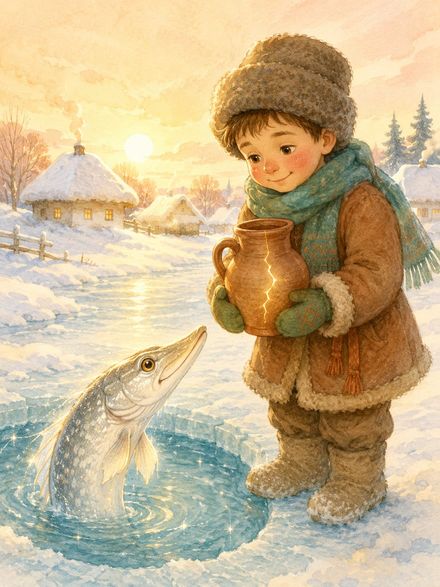
On the river the ice was clear, like a little window into another sky. Yemelya lowered his bucket into the ice-hole — and suddenly silver flashed in the water. Not a coin, not a spoon, not a splinter of the moon, but a Pike: sharp-nosed, dignified, with eyes in which whole winter tales were swimming.
“Let me go, Yemelya,” she said in a voice like the ring of an icicle in a glass. “And I will give you a word.”
“What word is that?” Yemelya wondered. “Our house is full of words: ‘sweep up,’ ‘fetch this,’ ‘don’t forget.’”
“My word is magic,” said the Pike. “Say: ‘By the pike’s command, by my own wish’ — and whatever you ask for will happen.”
Yemelya narrowed his eyes.
“And if I ask the buckets to walk home by themselves?”
“They will,” the Pike nodded. “Only remember: a wish has a heart. Whatever the heart, so goes the road.”
Yemelya honestly heard only the first half, because the second half sounded too much like his mother’s important words. He let the Pike go, filled the buckets, and solemnly whispered:
“By the pike’s command, by my own wish — go home by yourselves, buckets!”
The buckets jumped up, bowed to one another, and set off along the path. The left one walked with dignity, the right one danced along, splashing little diamonds of water.
The village had never seen buckets walking without a person. The dog Barsik barked so amazed that he interrupted himself. Old Granny Palazhka pulled a pie out of the oven and forgot why she was holding it in her hands.
“A wonder!” she said. “The buckets are cleverer than my cat.”
“Meow,” answered the cat from the windowsill, in a tone as if he were holding a secret council with kings.
Yemelya walked behind and felt as important as a button on a holiday shirt. He liked that everyone was watching. He liked it very much.
So he wished for more.
“By the pike’s command, by my own wish — let the sled carry me around the village by itself!”
The sled leapt out from under the shed, scooped up Yemelya, and rushed down the street. The wind sang in his ears, the houses swayed, the hens scattered, and one crow cried crossly:
“Caw! This isn’t riding, this is disrespect to the air!”
Yemelya laughed. The sled raced around the well, the gardens, the village hall, and nearly crashed into Granny’s fence. Yemelya managed to whisper a new command, and the sled stopped. The fence swayed, but held firm with the dignity of an old grandfather.
Only by the well stood little Marichka with an empty jug. The water from her jug spilled out when the sled flew past.
“I didn’t mean to,” said Yemelya.
“You meant to ride,” Marichka answered quietly. “But your wish knew nothing about my jug.”
Her words fell into the snow not loudly, but deeply.
In the evening Yemelya sat on the stove and watched the flames lick the logs with little ginger tongues. The magic word lay under his tongue like a sweet he was sorry to bite into.
“Mama,” he asked, “if a wish can do anything, then why does it sometimes feel a little tight in my chest afterwards?”
His mother thought and answered:
“Because the chest is a home for the heart. When the heart grows, the old walls creak.”
Yemelya said nothing. He took Marichka’s jug, which had cracked when it fell, and carried it to Hnat the craftsman.
Hnat had a moustache like two question marks, and he spoke briefly, as if hammering nails.
“We’ll mend it,” he said. “But the crack will remember.”
“And if it were magic?” Yemelya whispered.
“Magic is when you don’t see the work,” Hnat grumbled. “And good is when you see the care.”
Yemelya went outside. Over the village hung the moon — thin, like a silver scale. And suddenly it seemed to him that somewhere under the ice the Pike was listening.
The next morning Yemelya came to the ice-hole again. He took no sled, no buckets, no great pride. Only the cracked jug and a warm kerchief for Marichka, because the frost pinched his cheeks as if it wanted to check whether they were real.
“Pike,” he called. “Are you there?”
The water stirred, and a silver head appeared at the edge.
“I’m here,” said the Pike. “Has your wish already learned to walk more quietly?”
Yemelya blushed.
“I want Marichka’s jug to be whole. And the water in it to be clean. And I want... ” — he hesitated — “I want to carry it home myself, because my legs were given to me for something too.”
The Pike looked at him for a long time. Then she smiled the way only fish can smile: almost invisibly, yet with all the water.
“Speak.”
Yemelya took a breath.
“By the pike’s command, by my own wish — let the jug be whole for Marichka.”
The crack on the jug did not disappear. It began to glow with a thin golden thread, as if someone had sewn a ray of sun onto the clay.
“Why did it stay?” Yemelya wondered.
“Because now it isn’t a wound,” said the Pike. “It’s a memory that doesn’t hurt.”
Yemelya carried the jug carefully, with both hands. The water inside splashed softly, as if it were learning a lullaby. Marichka opened the door and first looked at the jug, then at Yemelya.
“It’s beautiful,” she said. “As if a lightning bolt lives in it that decided to be kind.”
“It wasn’t me,” Yemelya began.
“It was you,” his mother interrupted from behind the table. “Because you can ask in different ways.”
That day Yemelya still used the pike’s word. He wished that Granny Palazhka’s pie wouldn’t burn, that Hnat would find his lost hammer — but to make the buckets walk by themselves he no longer wished. He had suddenly come to like the sound of them jingling in his hands.
In the evening the village glowed with its windows, like a handful of warm nuts. And on Marichka’s jug the golden crack caught the light and gave it back — a little path along which even a wonder could come home not proud, but kind.
Listen to this tale narrated
Professional audio narration and many more tales for children aged 0–6 — in the Tale Tails app. Read or listen, even offline.
Get it on Google PlayQuestions & answers
What age is the tale “By the Pike’s Command” for?
“By the Pike’s Command” is best for children aged 5 to 7, though it is loved at any age.
Is there an audio narration of “By the Pike’s Command”?
Yes. A professional audio narration of “By the Pike’s Command” is available in the free Tale Tails app for Android.
Is “By the Pike’s Command” free to read?
Yes, the full text of “By the Pike’s Command” is free to read on this page, with no sign-up.
What is the moral of “By the Pike’s Command”?
Wishes become a true wonder when they hold not only wanting, but a kind heart as well.