Russian folk tale
Morozko
Morozko — a Russian folk tale about a girl whose hard-working hands and kind words warmed even the frost. Read the full text for free.
That morning winter had scattered sugary frost over the village, and little Marusya stepped onto the porch so early that even the rooster was still deciding what to be: an alarm clock or a pillow.
Marusya lived in a little cottage at the edge of the village, where the smoke from the chimney rose straight up, like a grey thread reaching to the sky. She was small, but her hands were nimble: they could fetch water, cover the bread with a cloth, and polish the old bench until it began to shine softly, as if remembering its youth.
“Oh, Marusya,” sighed her neighbour, Auntie Hanna, peering over the fence, “are you sweeping the snow too?”
“It asked to be gathered into a little heap,” Marusya smiled. “It lay and lay and grew quite lazy.”
The snow under her broom really did fold obediently into round white waves. And the wind, who loved to tickle people’s noses, grew quiet near Marusya, because he was curious: how can a child sing when her fingers are cold?
That day Mother asked Marusya to carry a bundle of pies to the old forester’s hut in the woods. The road was familiar: past the well, where the ice had blue eyes, past the birches standing in white mittens, all the way to the path among the fir trees.
“Walk slowly,” said Mother. “Don’t run, for winter loves to set silver traps under your feet.”
“I’ll make an arrangement with her,” answered Marusya. “I’ll say: ‘Winter, be polite, I’m carrying pies.’”
In the forest it was so quiet that you could hear the snowflakes arguing about which of them was the prettiest. Marusya walked, hugging the bundle to her chest, when suddenly she saw the path split in two. To the left ran the familiar tracks of a sleigh, to the right — tiny shimmering lights, as if someone had scattered stars right across the snow.
“How strange,” said Marusya. “Stars only wander about by day when they’ve lost their address.”
She bent down to look closer and heard a thin little voice:
“Don’t step on me! I haven’t finished shining yet!”
On the snow lay a tiny icy spark with whiskers like two little commas.
“I beg your pardon,” said Marusya politely. “Who are you?”
“Me? I’m the road-shine. I show the way to those who aren’t afraid to look beneath their feet.”
The shine winked, and the path to the right glowed brighter. Marusya thought of the forester, of the pies growing cold, and of the fact that unknown paths don’t always lead into trouble: sometimes they lead to where someone needs help.
She stepped to the right.
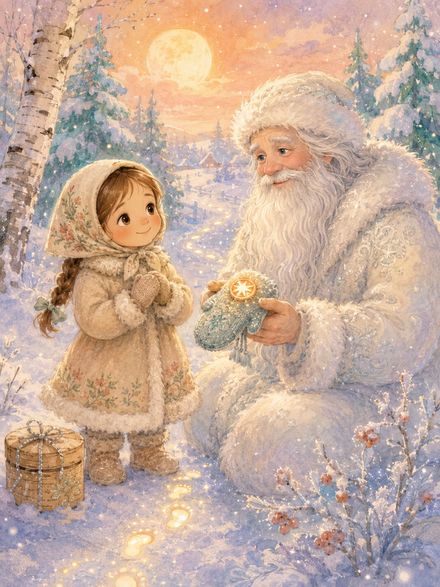
Soon a clearing appeared among the fir trees. In the middle of it sat an old man in a fur coat, white, so white, as if it had been sewn from the morning mist. His beard was long and silver, and his eyes were blue and attentive. He sat on a tree stump and tried to sew a button onto a mitten, but the thread kept turning into an icicle.
“Ho-ho,” he muttered. “The thread is stubborn, the needle is sleepy, the button has a mind of its own. What a day.”
Marusya guessed at once who he was. But she was not afraid. Morozko looked not frightening but very worried, like a grandpa who has lost his glasses even though they sit on his nose.
“Good day, Grandfather Morozko,” she said. “Is your mitten cross with you?”
“Cross?” Morozko asked in a deep voice. “It isn’t cross, it’s philosophising. It says: ‘Why a button, when one could be free?’”
“But fingers get cold without a button,” answered Marusya. “Let me try.”
She sat down beside him, breathed on the thread to make it softer, and quickly sewed the button on. Then she shook the snow out of Morozko’s felt boots, because, as it turned out, he had stepped into a snowdrift and forgotten to step back out.
“You don’t ask whether I’ll give you a gift,” said Morozko, narrowing his eyes.
“I’m carrying pies,” answered Marusya. “Gifts don’t like being tugged by the sleeve.”
Morozko laughed so hard that snow tumbled down from the firs, and one crow cawed indignantly:
“Caw! I’ve only just done my hair!”
“Forgive me, Madam Crow,” said Morozko. “Laughter doesn’t always walk on tiptoe.”
But suddenly the clearing grew dark. Not from fear, no. The sun had simply hidden behind a cloud, and with it the shimmering lights vanished. Marusya looked around: the path back was nowhere to be seen.
“Oh,” she said quietly. “The forester will be waiting.”
“The forester will be waiting,” Morozko nodded. “And the kettle in his hut is already getting cross. Do you hear it?”
And indeed, from far away came a thin sound: “Puff-puff-puff! I’m not boiling just for show!”
Marusya stood up.
“Then I must go.”
“But it’s dark,” Morozko remarked.
“Dark is when the eyes have forgotten to look for the light,” said Marusya, and she lifted up the icy spark, the very one with the comma-whiskers. “Mister shine, are you still working?”
“Overtime,” the shine squeaked proudly. “But for a kind word, I can.”
He glowed softly, like a little window in a faraway house. And then Marusya saw: on the snow, footprints had appeared — not hers, not the sleigh’s, but Morozko’s big round prints, leading straight to the hut.
The old forester met Marusya at the door.
“I was beginning to think the pies had got lost and started a household of their own,” he said, taking the bundle.
“They held out bravely,” answered Marusya. “Only one smelled so brave that I nearly gave in.”
Inside the hut it was warm. The kettle puffed, the forester sliced the pies, and outside the window someone knocked softly. Marusya opened the door — on the threshold lay a small birch-bark box tied with a silver thread.
Inside was a little fur coat, light as a small cloud, warm as Mother’s palm. Beside it lay mittens, and on them — an icy button, the very one Marusya had sewn, only now it glowed from within with a golden light.
On the lid was written: “To the one who knows how to give warmth with hard-working hands.”
Marusya touched the little fur coat, and it seemed to her that it remembered everything: the broom in the morning snow, the kind word to the shine, the button on the mitten, the road through the forest. And outside Morozko ran his finger along the windowpane and drew a flower of ice — so delicate that it looked like a frozen song.
When Marusya was walking home, night had already lit the first star. The girl walked in her new fur coat, and her footprints in the snow did not vanish at once: for a long while they still trembled with a warm light, as if winter itself had remembered where kind work had stepped.
Listen to this tale narrated
Professional audio narration and many more tales for children aged 0–6 — in the Tale Tails app. Read or listen, even offline.
Get it on Google PlayQuestions & answers
What age is the tale “Morozko” for?
“Morozko” is best for children aged 5 to 7, though it is loved at any age.
Is there an audio narration of “Morozko”?
Yes. A professional audio narration of “Morozko” is available in the free Tale Tails app for Android.
Is “Morozko” free to read?
Yes, the full text of “Morozko” is free to read on this page, with no sign-up.
What is the moral of “Morozko”?
Kind hands ask for no reward, yet the world notices their warmth all the same. Sometimes a gift arrives quietly — like light in the footprints on the snow.